
Roaring through Stories
Majestic and fallible, feared and befriended, lions embody various moods and meanings in literature. Storyteller and educator Deeptha Vivekanand explores what lions do in children’s books, and what they let children do.
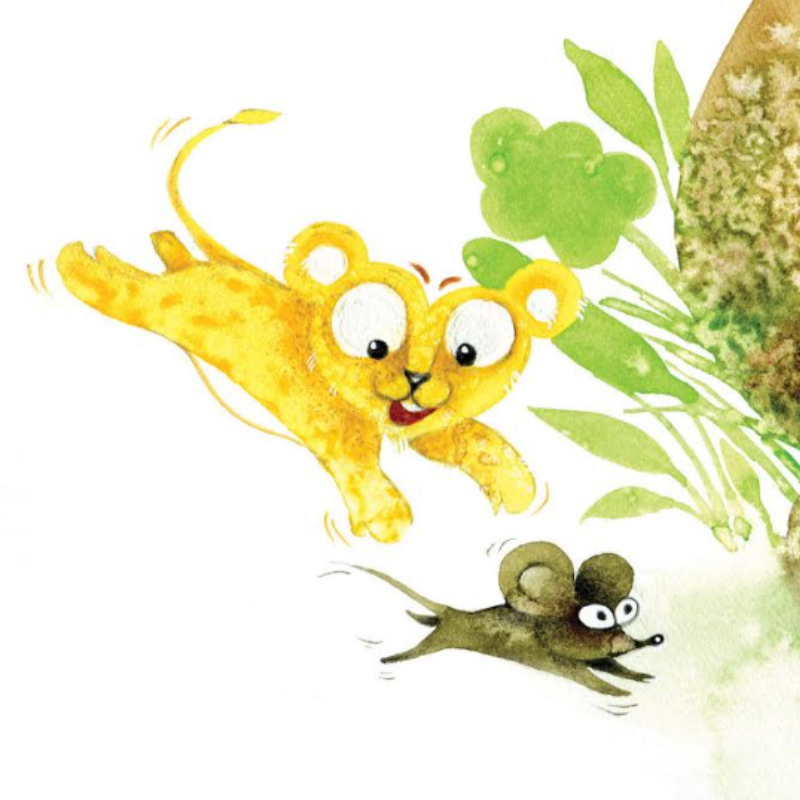
Image from Watch Out!/Ajanta Guhathakurta (Tulika)
Details
The first and only story my father ever told me was Kutty Singam Kadhai or Story of the Lion Cub. It was essentially a retelling of the Aesop fable The Lion and the Mouse with a twist, but I never let him complete it. I didn’t like the part where the lion got caught in the net. In his version, the cub would go on to rescue the lion with the mouse’s help. But I was too caught up in the tension between father and child going through a struggle. Perhaps I was too young – and something about the mighty lion being vulnerable, or needing saving, unsettled me. That discomfort has stayed on.
What is it about lions that so powerfully captures a child’s imagination? In children’s literature, lions are often caught in a tangle of contradictions: majestic and fallible, feared and befriended. In Indian children’s books especially, the lion shapeshifts across folktales, forests, and city streets, slipping between moods and meanings. What do lions do in children’s books, and what do they let children do? What does it mean to imagine power, play, and vulnerability – both emotional and environmental – through the figure of a lion?
Prowling through folklore
The lion has long ruled the world’s oral storytelling traditions as a powerful symbol in fables. In The Lion and the Fox by Deepa Balsavar and Amrita Kanther, a fox outsmarts a lion. Layered beneath the classic outwitting-the-strong tale is a subtle message about forest destruction and the ecological cost of human actions.
Gita Wolf and Indrapramit Roy’s The Very Hungry Lion retells a folktale through stunning Warli art. Here, the lion becomes a creature of appetite and arrogance, believing that he can outsmart his prey only to find that he’s the one who is getting tricked every single time!
These stories show how lions, even in their fearsome avatars, are repeatedly challenged or humbled – folklore’s way of reminding us that true power lies in balance and wit.
Breaking the mould
In many picture books, the lion breaks free from being typecast as the ferocious ruler of the jungle. Instead, it becomes a figure of humour, tenderness, or quiet self-discovery, encouraging children to see strength in softness and vulnerability.
A lion walks into a salon in Swati Shome and Sayan Mukherjee’s Lion Goes for a Haircut, tries out various hairstyles on an app, and ends up scaring everyone away. A delightfully silly premise becomes a gentle story about freedom, confidence, and body image.
Radhika Chadha and Priya Kuriyan’s Snoring Shanmugam features a lion so sleepy and mild-mannered that other animals question his role as the jungle guardian, until his mighty snore saves the day. A whimsical reminder that even flaws can become strengths. A similar theme comes through in Rachel Bright and Jim Field’s The Lion Inside, where a meek mouse seeks courage from a lion, only to learn that bravery comes in all sizes.
Ari by Vaishali Shroff and Kavita Singh Kale tells the story of a boy who, disappointed at being left out of a school play, processes his emotions by role-playing a lion at home. It playfully reminds young readers not to let rejection determine their future.
Wandering into the world
Some stories explore the lion’s surreal entry into human settings: homes, cities, libraries. Inspired by the iconic marble lions outside the New York Public Library, Michelle Knudsen and Kevin Hawkes’ picture book Library Lion narrates a story about one of the lions coming to life, wandering into the library and finding hilarious ways of minding and bending the library rules.
In R. Amarendran and Ashok Rajagopalan’s Salim the Knife Sharpener, a lion becomes Salim’s unexpected customer. The whimsical story blurs the line between man and beast while placing interdependence front and centre. Meanwhile, Paro Anand and Avishek Sen’s Lion on the Loose brings a lion into a rain-drenched city, prompting a funny and tense adventure that gently critiques captivity.
A warm exploration of fear, gentleness, and courage, All for a Roar by Nandini Nayar and Ankita Thakur tells the story of little Pranav, who wants more than anything else to roar like a lion.
The Lion’s Feast by Lavanya Karthik and Chetan Sharma features a greedy lion whose dinner plans are foiled to hilarious results. A playful look at power, appetite, and hospitality, this book invites readers to make up their own ending.
Lions as they live and roar
Amid these imaginative portrayals, only a few books ground the lion in its actual habitat – India’s Gir forest. Meera Sriram and Praba Ram’s Dinaben and the Lions of Gir offers a rare glimpse into the Maldhari community’s life with lions. Through evocative photographs and simple text, it portrays lions not as threats, but as trustees of the forest. Dinaben’s peaceful coexistence with the lions brings alive the urgent need to protect their habitat.
Watch Out! by Shamim Padamsee and Ajanta Guhathakurta, also inspired by the Gir lions, follows three curious cubs as they explore their world. With minimal text and striking art, it invites young readers to consider that even predators can be vulnerable.
These books shift the lion from a figure of imagination to one of ecological truth. They help readers see that lions are not just metaphors, but endangered beings surviving amid real-world tensions. In fact, there is a pressing need for more creative non-fiction about lions – stories that explore their habitats, their conservation, and the cultures co-existing around them.
As we lose these creatures from our forests, we risk losing them from our stories too. Indian children’s literature offers a surprisingly rich but uneven palette of lion portrayals. Yet the absence is also telling – we have lions of myth, but few of land. Perhaps, like the cub in Kutty Singam Kadhai, we need to rescue lions from the tales they have been trapped in, and instead tell stories where they are not just a symbol, but a living, breathing, roaring part of our world.
Bibliography
- The Lion and the Fox (Tulika)
- The Very Hungry Lion (Tara)
- Lion Goes for a Haircut (Tulika)
- Snoring Shanmugam (Tulika)
- The Lion Inside (Orchard Books)
- Ari (Tulika)
- Library Lion (Candlewick)
- Salim the Knife Sharpener (Tulika)
- Lion on the Loose (Pratham Books)
- All for a Roar (Eklavya)
- The Lion’s Feast (Karadi Tales)
- Dinaben and the Lions of Gir (Tulika)
- Watch Out! (Tulika)
- The Lion and the Mouse (Little Brown)
About the author:
Deeptha Vivekanand is a Storytelling & Reading Consultant who works with teachers, children, and communities, exploring how stories — old and new — shape the way we imagine the world.