
Of Hunger and Hope
Bibliophile and bookstore assistant Medha Rao writes about why a harvest of children’s books on food security is perhaps the best thing to sow this World Food Day.
Details
To be able to go to bed at night on a full stomach is not something that everyone can take for granted. In fact, for more than 700 million people around the world, it is a luxury to survive a day without experiencing the gnawing pangs of hunger — even as nearly a third of all the food produced every year is squandered or spoiled before it can be consumed.
Why do so many people go hungry, even when the world produces enough food to nourish every single person living in it? Because hunger isn’t always about the lack of food, but about the lack of access to it.
As Nobel laureate Dr Amartya Sen puts it: There is much to fear in a day that begins without a meal… The tragedy in… this lies not only in the bleakness of the real world in which Indian children live, but also in the fact that these deprivations are not hard to overcome, even within the means that India now has.
Although not abundant, fortunately we do have a small crop of children’s books that thoughtfully introduce the idea of hunger and food security to young readers.
Weather Woes
The climate crisis is an important trigger of food insecurity. In a drought-prone country like India, the lack of sufficient rainfall is a major reason behind crop failures, and a small clutch of children’s books turn the spotlight on this issue. Compiled by the students of the Aadharshila Shikshan Kendra at Sakad village in Madhya Pradesh, Eklavya’s Rookhi-Sookhi offers poignant and informative insights on drought. Using photographs, illustrations, observations and stories, this non-fiction book weaves a visceral account of a drought as witnessed by tribal communities in the Nimad region of the state.
While droughts occur because of multiple reasons, the result is always the same: households with barely any food to sustain their residents. Akal aur Uske Baad is a well-known poem on the brutality of a famine, penned by Nagarjun, a Janakavi (People’s Poet) from Bihar. This has been turned into a beloved picture book, illustrated by Karen Haydock, which shows the plight of a family when there is no food during a famine and the light that returns to their eyes when grains return to the fields and into the empty vessels.
In Kiran Manjunath and Niharika Shenoy’s From the Fish Basket, the fish-loving protagonist Kalpana is filled with anxiety when the fish-seller Meenamma doesn’t turn up at her home for many days. In the course of the picture book, readers realise that a hurricane has disrupted the supply of fresh fish in the coastal town, as none of the fishing boats can leave the harbour.
Poor Economics
Social injustice is both a cause and an outcome of food insecurity. Very often lack of access to food boils down to extreme poverty and many children’s books paint vivid portraits of such deprivation. When money for food becomes tight in Erin Talkin and Sheryl Murray’s Lulu and the Hunger Monster, the eponymous protagonist is overcome by monstrous hunger that takes over her life.
Meghaa Gupta and Habib Ali’s picture book A Home of Our Own takes a heartwarming look at how a group of street kids deal with hunger by playing house. Much of what they bring together — make-believe utensils, groceries, vegetables and dough for rotis — points to the significance of food in their imagination of a home. A similar sense of hunger pervades Padma Venkatraman’s The Bridge Home, a heartrending novel about homeless children who survive by scavenging trash heaps in a city.
Some books dive deeper into the idea of poverty, closely examining its intersection with other social inequities. Muskaan’s edition of Tamil writer Bama’s short story Pongal, illustrated by Karen Haydock, is a blistering account of a Dalit family weighed down by the unjust tradition of offering food to the landlord even as they themselves are starving.
What a Waste!
Despite pervasive hunger, a large amount of food that gets produced is wasted in a variety of ways. In Ashwitha Jayakumar and Tarique Aziz’s picture book, What’s that Smell?, a family returns home, hungry and eager for dinner, but is met with a smelly ‘fridge monster’ — their fridge has stopped working and the stink of spoiled, inedible food has taken over their home.
Many times people become so complacent with the abundance of food available to them, particularly during marriages, festivals and other social gatherings, that they wilfully cause an immense amount of waste. Think Eat Save by Sandhya Rao takes a deep look at food wastage and reminds readers to eat responsibly, reuse leftovers and share food with others.
Sharing is Caring
Sharing food is a universal language of love, and in a world raging with hunger, many children’s books shine a light on it. Praba Ram, Sheela Preuitt and Shilpa Ranade’s Thukpa for All is a beautiful picture book that talks about the generosity of cooking for everyone. The household in the story is not without its struggles, and to make matters even more challenging, in the middle of preparing food the lights go out. Yet the young protagonist Tsering persists in his efforts to treat everyone to his grandmother’s delicious noodle soup (thukpa).
A similar sense of care comes through in Richa Jha and Sumanta Dey’s Machher Jhol, which follows a young boy in his trek through a busy city to bring home his father’s favourite dish and comfort him while he is sick.
Children’s stories about hunger don’t just speak of empty plates — they remind us that every meal shared, every grain saved and every act of kindness can feed far more than a stomach. They nourish empathy — the first ingredient for a fairer, fuller world.
Bibliography
- Rookhi-Sookhi (Eklavya)
- Akal aur Uske Baad (Eklavya)
- From the Fish Basket (Moggu Books)
- Lulu and the Hunger Monster (Free Spirit Publishing)
- A Home of Our Own (Tulika)
- The Bridge Home (Nancy Paulsen Books)
- Pongal (Muskaan)
- What’s that Smell? (Pratham Books)
- Think Eat Save (TERI Press)
- Thukpa for All (Karadi Tales)
- Machher Jhol (Pickle Yolk Books)
- Head Curry (Eklavya)
- Something to Chew On (Kalpavriksh Publications)
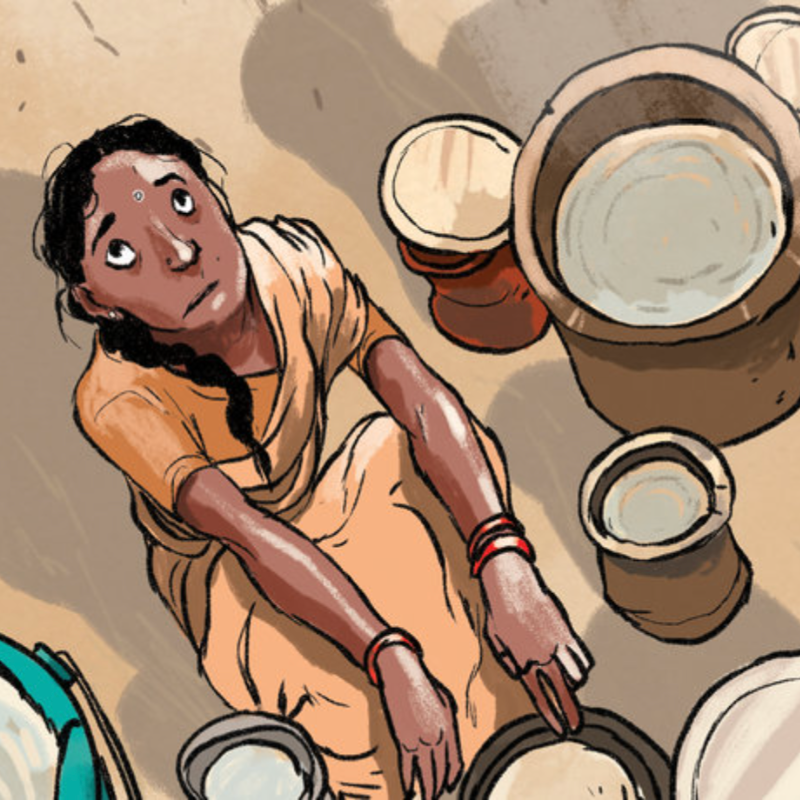
Image from The Case of the Missing Water/Upamanyu Bhattacharya (Pratham Books)
About the author:
Medha Rao teaches theatre to middle schoolers at The Valley School and also works at Funky Rainbow, an independent Indian children’s bookstore in Bengaluru. She loves reading books and writing wacky stories.