
Hiss Stories
The fear of snakes, or Ophidiophobia, is one of the most commonly reported phobias in the world. Varsha Verghese explores a collection of children’s literature that attempts to dispel it.
Details
On the very first page of English naturalist John Woodward’s Everything You Need to Know About Snakes and Other Scaly Reptiles, you learn that most snakes are not venomous – a fact that many adults and children quickly forget when they encounter these slithering reptiles. Of the 3,000 types of snakes in the world, only 600 species are venomous, of which only 200 can kill or significantly wound a human. Why, then, are so many of us afraid of these creatures? Some experts suggest that such fears are often learned from families and rooted in superstition. But could this also be an outcome of the way in which snakes have historically been represented in children’s stories?
Problematic portrayals
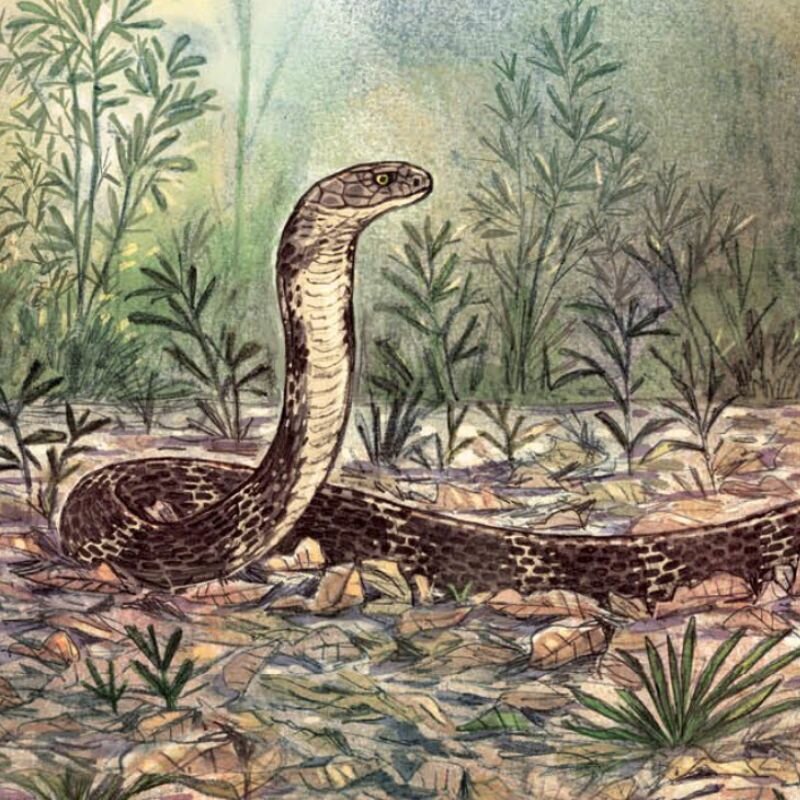
One of the most popular stories in English textbooks is Rudyard Kipling’s Rikki-Tikki-Tavi, where two cobras plot to kill the human occupants of a bungalow, only to be thwarted by the eponymous mongoose. In addition to portraying snakes as wicked creatures, the story also perpetuates the myth that they seek vengeance when their mate is hurt. Similarly, in The Farmer and the Snake, a story in Aesop’s Fables, a farmer finds a snake stiff and frozen in the cold and looks after it, but when the snake recovers, it bites him. The bite proves deadly, and as the farmer draws his last breath, he tells those around him, ‘Learn from my fate not to take pity on a scoundrel.’
Such portrayals often stand in sharp contrast to the revered position of snakes in religion and mythology. Aboriginal people in Australia, for example, worship the Rainbow Serpent, a deity who conjures up land and natural resources but can wreak havoc when disturbed. India too has several temples dedicated to serpent deities. This piety also finds a place in many children’s books. The Magic Grove, a comic book published by Amar Chitra Katha, is a Jain tale about destiny where a young girl who protects a snake from snake charmers is rewarded with a boon that eventually makes her the queen of Pataliputra. Similarly, Suvadip Bhattacharjee’s Manasa, The Snake Goddess celebrates the folk goddess Manasa, who is worshipped as the protector of snakes in different parts of Bengal.
Demystifying dilemmas
A number of books attempt to dispel irrational fears through narratives that challenge popular myths and offer useful information. In Making Friends with Snakes (But from a Distance), cartoonist Rohan Chakravarty deploys his trademark humour to help readers identify the four venomous snakes found in India and what to do if they meet one! Rachel Poliquin’s How to Promenade with a Python (and Not Get Eaten), illustrated by Kathryn Durst, is similarly cheeky non-fiction where Celeste, a sassy cockroach, tells readers how to take a pleasant walk with a very large snake without running into tricky problems. Boa’s Bad Birthday by Jeanne Willis and Tony Ross, meanwhile, will have young children laughing along as a Boa receives birthday gifts that have no use for him, like a piano (no fingers), mittens (no hands), sunglasses (keep slipping off because he has no nose), a hair brush (no hair) and a football (no feet)! Readers looking for more information can always pick-up Zai and Rom Whitaker’s The Snakes Around Us, a handy guide on the lives of snakes, their behaviour and ecological importance.
Many stories help readers confront fears by normalising human-snake interactions. Zai Whitaker and Rajiv Eipe’s picture book Ajay of Agumbe and the Signal Snake, inspired by snake specialist Ajay Giri who works in the Agumbe Rainforest Research Station in Karnataka, shows him setting off into the forest with an antenna, radio and a waterproof notebook to record his observations about the king cobra. The book offers readers a rich insight into the forest ecosystem and techniques employed by wildlife researchers.
In Ruskin Bond’s Snake Trouble, a grandfather buys a young python from a snake charmer and brings it home, slung over his shoulder. The story is filled with the brief and chaotic appearances of the python at odd places around the home and, eventually, even when travelling with the family on a train! Vatsala Loves Snakes! by Arthy Muthanna Singh, Mamta Nainy and Divya George, and Living with Adi by Zarin Virji, feature child protagonists with an avid interest in these reptiles.
While snake charmers briefly appear in many children’s stories, it is rare to find books that focus on communities whose lives are closely associated with snakes. Zai Whitaker and Srividya Natarajan’s picture book Kali and the Rat Snake turns the spotlight on the Irulas, a marginalised tribal community in Tamil Nadu, who collect a bulk of the venom for anti-venom manufacturers in India and then release the snakes back into it the wild. In the story, Kali, the son of a famous Irula snake catcher, struggles to make friends at school until a rat snake appears in the classroom, wreaking havoc.
Snakes are essential to our planet’s ecosystem and play an important role in keeping rodents at bay. However, too many myths and false stories have amplified fears around them. Hopefully, children’s books with positive depictions of these misunderstood reptiles will debunk stereotypes and encourage young readers to respect and admire them.
Bibliography
- Everything You Need to Know About Snakes and Other Scaly Reptiles (Dorling Kindersley)
- The Magic Grove (Amar Chitra Katha)
- Manasa, the Snake Goddess (Om Kidz)
- Making Friends with Snakes (but from a distance) (Pratham Books)
- How to Promenade with a Python (and Not Get Eaten) (Tundra Books)
- Boa’s Bad Birthday (Andersen Press)
- The Snakes Around Us (National Book Trust)
- Ajay of Agumbe and the Signal Snake (Pratham Books)
- Snake Trouble (Penguin)
- Vatsala Loves Snakes! (Karadi Tales)
- Living with Adi (Duckbill)
- Kali and the Rat Snake (Tulika)
- Frogs and a Snake (National Book Trust)
- Little Snake Plays Hide & Seek (Scholastic)
- Hiss, Don’t Bite! (Tulika)
- The Snake and the Frogs (Tulika)
- Cobra in my Kitchen and Other Adventures with Wildlife (Hachette)
- The Serpent’s Secret (Scholastic)
- Termite Fry (Bloomsbury)
About the author:
Varsha Verghese is a children’s book author and the winner of the Scholastic Asian Book Award, 2023. She writes on Indian Kidlit and has led a reading project for under-resourced children.