
Ghosts on the Roof of the World
In her curation of books on the feared, revered and vulnerable snow leopard, library educator Sowmya Ravindranath finds that its plight is a cautionary tale of shrinking habitats and climate change.
Details
One of nature’s most magnificent big cats, the snow leopard has had a storied existence. From featuring in emblems and Buddhist folktales to inhabiting the highest mountains in Central Asia, it is known to be notoriously elusive, adding to its allure.
Photographed for the first time in 1971 by zoologist George Schaller, the snow leopard has since then caught the attention of writers and conservationists from around the world. American writer Peter Matthiessen who accompanied George Schaller on a 250-mile trek to the Dolpo region in Nepal, wrote in his seminal book The Snow Leopard: “I would like to see a snow leopard, but if I do not, that is all right too.” Matheissen’s interest in Buddhism unravels in his explorations of the snow leopard as an analogy to ego and detachment, making this book more than an account of the natural world.
Sighting a snow leopard is considered a spiritual experience for the people of Ladakh. The most well-known Buddhist story is of the eleventh century saint Milarepa. When the saint had retreated to a cave in the highlands, his disciples feared he might have succumbed to the cold. But a snow leopard’s appearance leads them to a hidden cave. They trace the paw prints on the snow only to find Milarepa at the end of the trail.
The mystical animal is often referred to as the ‘grey ghost’ or ‘ghost cat’. The freezing cold, inhospitable terrains and perfect camouflage make sighting a snow leopard an exercise in patience, with luck decidedly turning the tables. This is captured in one of Rohan Chakravarty’s cartoons in The Great Indian Nature Trail with Uncle Bikky, where a still marmot betrays the presence of the wild cat.
In Deepak Dalal’s The Snow Leopard Adventure, the protagonist Vikram is unsure if his encounter with a snow leopard family was real: He wished this part of the dream was true because he could never have hoped for such a splendid encounter with the animals. The leopards had come so close to him. They were so life-like, so real and so beautiful.
Notwithstanding this mysticism, close encounters with the apex predator have also led to complex and urgent human-animal conflict in its terrain. Yangdol from the eponymous book scorns her mother for including the snow leopard in her prayers. Grieving the death of her lamb, the little girl says, “Shouldn’t we be angry? Should we not seek revenge? Our poor sheep!” The creators of the book Pankaj Singh and Athulya Pillai offer a poignant glimpse of what it means to live with the dual reality of fear and reverence for the snow leopard.
In Sujatha Padmanabhan and Madhuvanti Anantharajan’s The Ghost of the Mountains, sixteen-year-old Rigzin finds himself at the centre of a raging debate amongst the locals. Loss of livestock is driving the community to consider poisoning the snow leopard that has crept into their village. Rigzin convinces his community to look beyond the immediate problem. “There are only 5000 snow leopards left in the world. Some of these animals are being killed by angry villagers who have lost their livestock. Many are killed for their fur and bones,” he implores.
Classified as ‘Vulnerable’ by the International Union for the Conservation of Nature (IUCN), the snow leopard population in the world has reportedly declined by about 20% over the past twenty-five years. A recently concluded survey (Snow Leopard Population Assessment in India) that spanned four years, found that India has around 718 snow leopards in the wild. This draws attention to the need for conservation efforts and puts the spotlight on local communities.
Nature Conservation Foundation’s books for young readers feature accounts of conservationists and field workers from the local community. In Our Encounter With a Snow Leopard, illustrated by Tanushree Roy Paul, author Sherab Lobzang recounts her early experience of coming face-to-face with the wild cat near her village in Ladakh. Similarly, in Gyalmo, the Queen of the Mountains, illustrated by Komal Jain, conservation scientist Ranjini Murali writes about the adventures of Lobzang and Koyna as they go about trying to spot a snow leopard. Books that feature real people in conservation provide a glimpse into their work that is often the result of arduous hours ridden with tremendous risk.
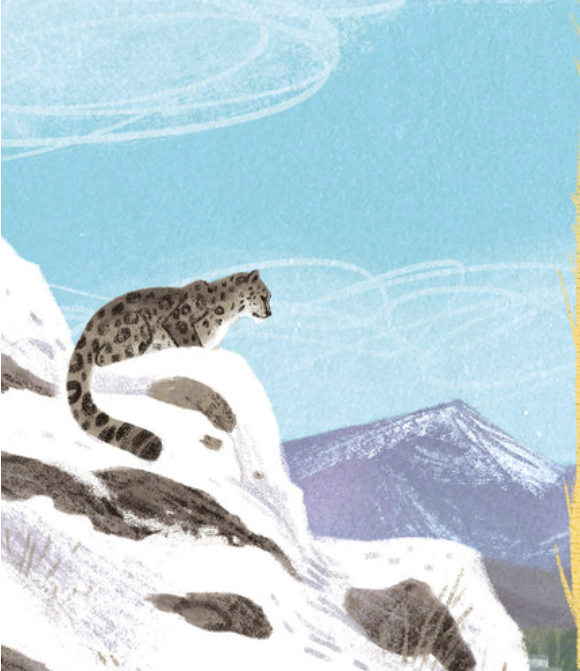
In a warming world, where the snow cover is declining with each passing decade, it’s not hard to sense the grave danger facing these majestic wild cats. Bijal Vachharajani elucidates this in a moving letter that appears in her epistolary picture book PS: What’s Up with the Climate?, illustrated by Archana Sreenivasan:
Oh, lucky Bear
We didn’t get much snow all winter.
So I had to climb up, up and up to get to the snow.
But my food went down, down, and down to get to their food.
So then I went down, then back up.
Then back down and up. Aaaaaah!
Try running around with so much fur when it’s hot.
Also, mud rolls are not the same as rolling in the snow.
Sulking,
Snow Leopard
As wilderness grows impoverished due to climate change, poaching and shrinking habitats, we rely on the humour, wonder and sense of inquiry that children’s books evoke, to keep the conversation on conservation alive.
Bibliography
- The Ghost of the Mountains (Kalpavriksh)
- The Snow Leopard Adventure (Penguin)
- The Great Indian Nature Trail with Uncle Bikky (WWF-India)
- Wild Cat! Wild Cat! (Pratham)
- Gyalmo, the Queen of the Mountains (Pratham and Nature Conservation Foundation)
- Our Encounter with a Snow Leopard (Pratham and Nature Conservation Foundation)
- Yangdol (Self-published)
- PS: What’s Up with the Climate? (Pratham)
*Photo Credit: PS: What’s Up with the Climate? (Pratham)
About the author:
Sowmya Ravindranath is a library educator, who is deeply interested in making libraries safe spaces for children to explore their inner and outer world. She can be contacted on sowmya.ravindranath@gmail.com