
Forest Fables
On the International Day of Forests, children’s librarians Radhika Sathe Mantri and Sudeshna Shome Ghosh show us how books can perhaps be the best guardians of our shrinking forested landscapes.
Details
Over half a decade ago, we walked down a beautiful leafy lane somewhere in the bustling city of Bangalore. The tall trees on the road bent and swayed in the wind, welcoming us — two children’s librarians — as we set up a library in the lane. The magnolia dropped its flowers with abandon, and often a child would be found reading a book sitting under its branches, a flower tucked behind the ears. The mighty neem shook its leaves and dropped its fruits when summer storms blew through the road. The Bilimbi tree with its sour green fruits delighted in showering squishy treats on our path, and we had to be careful not to go wildly slipping on them.
And then, suddenly, a construction boom caught up with this lane. The quiet that we knew and loved was now broken by the sounds of jackhammers and diggers going up and down the road. Where we would hear the koel and the munias and the squirrels incessantly chirruping in their nests and on branches, we now heard the chaos that comes when humans build their homes.
One day, as the noise rose to horrible decibels, we stepped out to investigate. A beautiful yellow cassia tree was coming down. Its brilliant yellow flowers had greeted us often, blowing around, covering the road. With heavy hearts, we did what librarians and readers do everywhere in order to stop the sadness — we looked for books on our shelves that we could pull out, read and share with children.
Here are a few of our favourite books on trees and forests from the shelves of our library…
Forests of Life
The Rumbling Islands: True Stories from the Forests of India, edited by Zai Whitaker, is an engaging anthology featuring the writings of eminent conservationists, naturalists and nature lovers such as Ramachandra Guha, Bittu Sahgal, Rom Whitaker, George Schaller and Sally Walker. From the mountains of Kerala and the coffee plantations of Karnataka to a rumbling island in the Nicobar, the book is an ode to rich and diverse forest landscapes of India and their wildlife.
In Prabhat and Allen Shaw’s Lightning, a book in Hindi, a mighty tigress roams the forests of Ranthambore. Everyone knows this gorgeous animal — from the monkeys and kingfishers to the children walking to school and the villagers tilling their fields. There is respect, but there is also love — shown on the walls of the village huts with their traditional drawings of the tiger. One day, the tigress Lightning has a terrible accident, and it requires the skills and determination of the forest department and the villagers to come to her rescue. A strikingly illustrated big book, this one is perfect for classroom read-alouds and discussions, or to just sit down with and get transported to the grasslands and lakes of Ranthambore.
One Night in the Sunderbans by Tannaz Daver and Ratna Moriniaux Rege introduces children to the delicate ecosystem of mangrove forests through the eyes of little Diya and her pet goat Mishti. The book takes readers on an overnight adventure through the mangroves, where Diya and Mishti encounter the King Cobra, crocodiles and of course the royal Bengal Tiger. The story gently shows the reader, through words and illustrations, to respect the forest and live in harmony with it.
Animals in the Spotlight
There’s nothing quite like having a bunch of smart-alecky animals taking the reins of a story firmly into their hands (well, paws, or perhaps claws), making life in the wild immediate and accessible to young readers.
The Old Animals’ Forest Band by Sirish Rao and Durga Bai, a much-loved Indian version of a popular Grimm Brothers’ folktale, tells the story of four talking and singing animals — a dog, a cow, a donkey and a cockerel — who are thrown out by their owners when they become old and ‘useless’. The animals band together, crack a case of theft and live happily ever after, showing the selfish and mean humans exactly what they feel! The Gond-style illustrations are a large part of the charm of this jungle book.
Ranjit Lal has long been one of our favourite writers — for his wit and his expansive knowledge of nature and Indian wildlife that he can seamlessly spin into enduring books for children and young adults. In The Tigers of Taboo Valley, a middle-grade novel set in a forest, a tigress is killed, leaving behind her four cubs. Willy-nilly and against his better judgement, their father, the mighty Rana Shaan-Bahadur, decides to protect his children (male tigers rarely ever rear their young). What follows is a rollicking tale of adventure, filled with horrible poachers, a dastardly porcupine villain brigade, a wildlife photographer with luscious locks and tiger cubs who will steal your heart.
Gooseberry Park by Cynthia Rylant is a heartwarming story about animals and one good sort of a human. When a snowstorm strikes Gooseberry Park, a wooded area where animal friends live together, its denizens find themselves in grave danger. Stumpy the Squirrel has just given birth and her nest is destroyed in the storm. She is missing and her babies are all alone. Murray the bat, along with Kona the labrador and Gwendolyn the hermit crab, stage a rescue mission and bring the little squirrels to Professor Albert’s home. The book talks about loyalty, friendship and how animals are deeply affected by extreme weather and climate change.
Treasuring Our Forests
Population explosion, pollution and human encroachments are rapidly shrinking forested areas, pushing several species to the brink. Many children’s books spotlight these concerns and the need to protect forest ecosystems.
In Gulla and the Hangul by Mariam Karim-Ahlawat and Proiti Roy, young Gulla goes out in the morning to herd his sheep when he meets a little hangul, a shy and beloved red stag that lives in the valleys of Jammu and Kashmir. There is fantasy and the dazzling spirit of the eternal snows, but more importantly the story reflects on the plight of rare animals affected by habitat loss and the fracturing of an ancient yet living connection between the people of the region and their wildlife.
The Tiger of the River by Adrian Pinder and Maya Ramaswamy is a lushly illustrated story set in the waters of the River Kaveri that passes through the forests and ravines of the Western Ghats before flowing into the Bay of Bengal. It follows the mahseer Matisha, one of the largest freshwater fish on earth, as she swims upstream to lay her eggs. But what happens when human interventions block and pollute ancient routes? Do these precious journeys stop? The book asks these and other important questions about the interconnectedness of all life.
Year of the Weeds, a YA novel by Siddhartha Sarma, remains a favourite at our library. It seamlessly weaves forest rights and politics into the story of a young boy Korok, who lives in a Gond village in Odisha. When the village has to be vacated to make way for a bauxite mine, the villagers resist. At stake is their home and their sacred hill. In this story about the push and pull of mindless industrialisation and an unstoppable hunger for natural resources, the author gives voice to those who are rarely represented in children’s fiction — the ones most deeply impacted by environmental exploitation.
The best children’s books about forests are portals of imagination connecting young readers to the wilderness. As librarians it has been our pleasure to help children make these connections, one book at a time.
Bibliography
- The Rumbling Islands: True Stories from the Forests of India (Penguin)
- Lightning (Ektara)
- One Night in the Sunderbans (Leadstart)
- The Old Animals’ Forest Band (Tara)
- The Tigers of Taboo Valley (Rupa Publications)
- Gooseberry Park (Beach Lane Books)
- Gulla and the Hangul (Tulika)
- The Tiger of the River (Talking Cub)
- Year of the Weeds (Duckbill)
- Ambushed (Penguin)
- Ranthambore Adventure (Penguin)
- Jadav and the Tree-Place (Pratham Books)
- Chitty: A Dog and her Forest Farm (Kalpavriksh)
- The Spring of Life: How Moirangthem Loiya Saved a Forest (Kalpavriksh)
- The Girl who was a Forest: Janaki Ammal (Duckbill)
- Lady Tarzan! Jamuna Takes a Stand (Ektara)
- Jungle Mein Ek Raat (Eklavya)
- Walking is a Way of Knowing: In a Kadar Forest (Tara)
- In Bon Bibi’s Forest (Tulika)
- A Jungle Safari (Katha)
- We Are the Dancing Forest (Tulika)
- Flute in the Forest (Penguin)
- That Summer at Kalagarh (Tulika)
- Stories of Forests from India for Children (Shree Book Centre)
- The Tiger, the Bear and the Battle for Mahovann (Red Panda)
- Andamans Boy (Tulika)
- Tiger Boy (Duckbill)
- Welcome to the Forest (Pratham)
- When a Forest Wakes Up (Pratham)
- Who Ate All That Up? (Pratham)
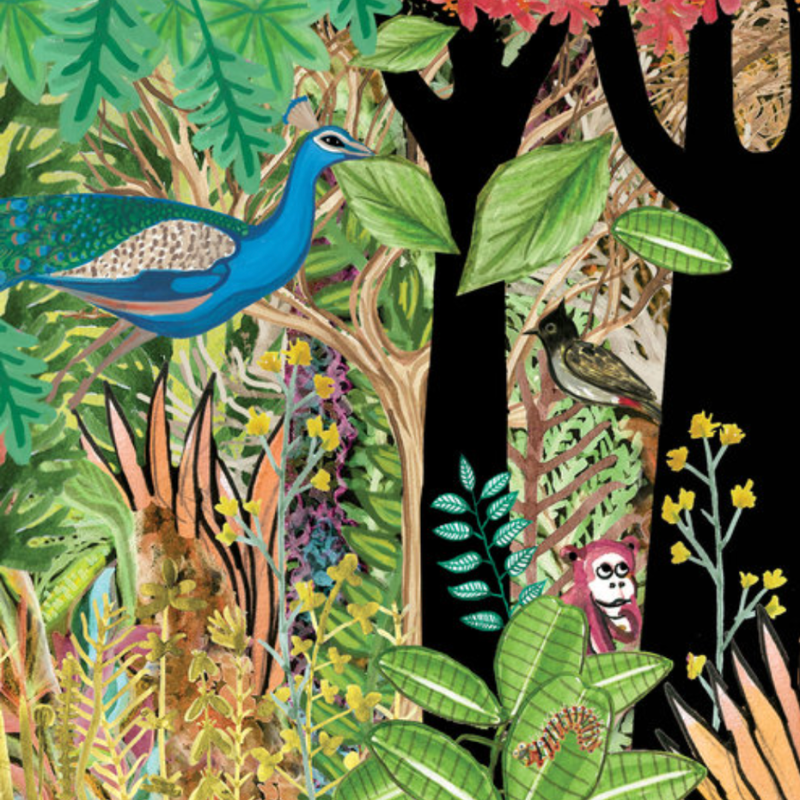
Image from Welcome to the Forest / Kavita Singh Kale (Pratham Books)
About the author:
Radhika Sathe Mantri and Sudeshna Shome Ghosh are the co-founders of the Cosy Nook Library in Bengaluru. Radhika is a Special Education teacher, with over a decade long experience in teaching in the US. Sudeshna has worked in the Indian publishing industry for nearly 30 years. She is Executive Publisher, and Head of Children’s Books at Speaking Tiger Books.