
J.C. Kumarappa
Gandhian Thinker
By Amit Basole
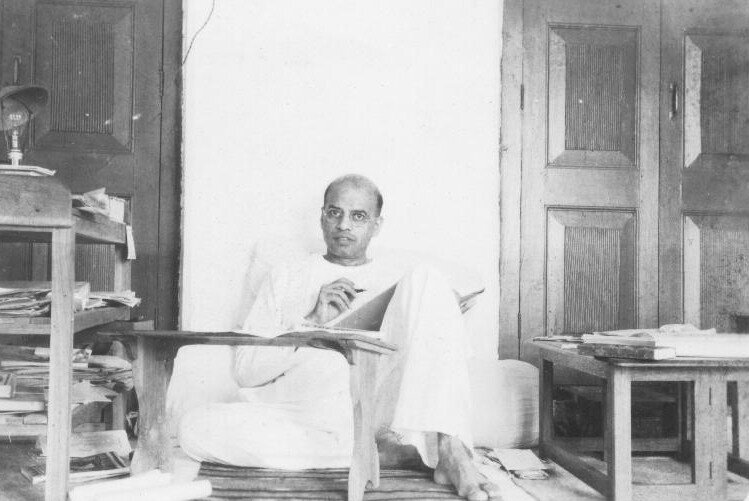
An anecdote associated with the economist J.C. Kumarappa illustrates both his worldview and his personality1. The time was soon after India’s independence. The Planning Commission Advisory Committee was meeting at the Rashtrapati Bhavan in New Delhi. Kumarappa was making his way to the meeting in a horse-drawn tonga but was ordered off the road because Jawaharlal Nehru’s motorcade was to pass. In response, he threatened to arrive the next day in a bullock cart, adding for good measure that, in a democracy, a Prime Minister and a bullock-cart driver were equal. Nehru explained that bullock carts are not allowed on these roads for their own safety, since the road is frequented by military trucks. Kumarappa responded that common sense would suggest that if one person was a threat to another then the restriction ought to be placed on the former. Behind this simple rejoinder lies the profound principle of sarvodaya, or the welfare of the last person.
Kumarappa was born Joseph Chelladurai Cornelius, in 1892, to a well-to-do Tamil Christian family in Thanjavur. He was one of nine siblings, all of whom went on to have distinguished careers. One of the most well-known among them was Bharatan Kumarappa, a fellow Gandhian and the first editor-in-chief of The Collected Works of Mahatma Gandhi. J.C. Kumarappa studied at Columbia University under E.A. Seligman, who had also been B.R. Ambedkar’s professor a few years earlier. Upon returning to India he settled in Mumbai as an accountant. Like many others, his life trajectory was radically altered when he encountered Mahatma Gandhi. In 1929, he threw himself wholeheartedly into the Gandhian movement.
He spent the next twenty years living in a small hut in the village of Maganwadi in Wardha district of Maharashtra, from where he coordinated the activities of the All India Village Industries Association (AIVIA). Reviving the rural economy became his life’s work. He was the only Gandhian on the pre-independence National Planning Committee (NPC), the forerunner of the National Planning Commission. In Independent India, he served as the chair of the government’s Agriculture Reform Committee and was involved in an influential report on Indian agriculture (the “Kumarappa Report”).
Kumarappa’s philosophical vision incorporated a range of influences from Christian theology and Thorstein Veblen (the nineteenth century evolutionary economist) to Gandhi. Kumarappa posits a “natural order” constituted by a web of rights and obligations. Ahimsa is the process of recognising these rights and obligations, and the fundamental interconnectedness of being, and conforming to them. Truth (in Gandhi’s sense of the word) is the goal of such action. Kumarappa’s practice is essentially the attempt to create institutions that would enable humans to act in accordance with these ethical and moral principles. In other words, as Govindu and Malghan point out, these men did not believe naively in the “goodness” of humans or in altruistic tendencies. But, they believed that collectively such institutions could be created to bring out these tendencies over others.
Among Kumarappa’s more well-known works are Economy of Permanence and Why the Village Movement, but he also wrote prolifically on public finance, planning, and above all on the ongoing experiments in village industries, khadi, and swadeshi. These articles were published in Mahatma Gandhi’s periodical Young India or in the Gram Udyog Patrika, and have later been collected as part of various volumes such as The Gandhian Economy and Other Essays, Swadeshi: The Moral Law of Self-reliance and Public Finance and Our Poverty.
Being a trained economist, Kumarappa produced economic arguments in support of village industries and a decentralised, locally controlled economy. For example, a common charge against these industries was one of inefficiency when compared to large-scale industry. Kumarappa pointed out that if public expenditure on research, development, and infrastructure as well as externalisation of costs to the environment were taken into account large-scale industry would appear much less efficient than it does.
Gandhi and Kumarappa, working together closely during the 1930s and 1940s, articulated a coherent theory and practice of labour-intensive, low-environmental impact, and decentralised industrialisation, which they both argued was crucial for assuring employment, autonomy, and dignity to every Indian. As Govindu and Malghan put it in their intellectual biography of Kumarappa, The Web of Freedom, “while Gandhi laid out the broad contours of an argument for swadeshi, it was Kumarappa who out of prolonged engagement shaped it into a theory of decentralisation.” Hence, Kumarappa has been called “Mahatma Gandhi’s economist” and the “Green Gandhian”. This approach began by placing ordinary farmers, workers and artisans at the centre of economic thought.
For those interested in the debates over industrialisation that occurred in the colonial period, a particularly rich one is that between Kumarappa and Jayaprakash Narayan on the merits and demerits of large-scale versus small-scale industry, which Govindu and Malghan’s book outlines. The issues raised, such as what is the appropriate scale of production, is efficiency the same as productivity, and what is the nature of progress, are still relevant for us today. Most significantly they force us to ask why certain techniques and forms of knowledge are seen as “progressive” and what happens if we accord more importance to equity than productivity. Incidentally, this “JC-JP” debate is much richer than the more famous debate over villages in the Nehru-Gandhi letters from 1945.
Sadly for India and indeed the world, the systematic theoretical and practical explorations by Kumarappa did not find a central place in mainstream scholarship or policy-making. One or two exceptions aside, such as India’s unique experiment in reservation of products for small – scale industry, the debate on India’s structural transformation did not find much use for these ideas.
Kumarappa’s sensitivity to interconnectedness of being, his insistence on “permanence” (what we might call “sustainability” today), and the distinction he made between “reservoir” and “current” economies — non-renewable and renewable respectively — make him an ecological economist. In his view, economic growth cannot be unlimited, and the principal task is to create institutions that organise the human economy in an equitable way that minimises the disturbance of the ecological balance.
We find a strong influence of the Gandhi-Kumarappa vision on the thought of the German-British economist, E.F. Schumacher who gave us one of the most memorable, if sometimes disparaged, phrases in the English language – “Small is Beautiful.” In his book of the same name, Schumacher (1973, p. 33) says:
From the economic point of view, the central concept of wisdom is permanence. We must study the economics of permanence. Nothing makes sense unless its continuance for a long time can be projected without running into absurdities. There can be growth towards a limited objective but there cannot be unlimited, generalised growth.
There seems little doubt that Schumacher got the idea of permanence from Kumarappa, who he quotes in the book along with Gandhi. Since Schumacher is considered a key figure in modern environmentalism, we may say that Kumarappa had a large influence on the world, if indirectly.
Local markets were a key institution in Kumarappa’s thought. Exchanges (markets) had to be primarily local, not only because distancing deprived consumers of the knowledge of production conditions and aided unethical practices, but also because long-distance transport of daily necessities was ecologically costly. Anticipating the days of consumer awareness and campaigns that encourage consumers to support local businesses, Kumarappa had the following list of questions for all consumers: What does one know about where the article comes from? Who makes the article? From what material? Under what conditions do the workers live and work? What proportion of the final price do they get as wages? How is the rest of the money distributed? How is the article produced?2
In Kumarappa’s words swadeshi is the “moral law of self-reliance.” He succinctly explained the moral basis of swadeshi as follows: “Those of us who apply human standards of value (to production) have to inquire into all aspects of manufacture. It is an arduous task and it becomes almost impossible for ordinary persons to undertake it when the articles come from far off countries” (p. 73). In more recent times, the idea of distancing has entered the vocabulary of modern economics.
Despite the urgency of the ecological crisis that faces modern capitalism, not to mention persistent inequalities, ideas of swadeshi and village industry seem too dated to be of use. Kumarappa’s work should push us to rethink them afresh and get to the principles that lay behind the practices. Even in their own time, Gandhi and Kumarappa often had to face the accusation that they were looking to the past and fighting a losing battle against modernisation. But this is a misunderstanding. In fact both men were committed to improvements in existing techniques and methods of organisation, as long they were consistent with the central modern value of equality. For them khadi, charkha, and decentralised small-scale industry were not to be championed because they were “traditional” nor were they to be preserved for the sake of “Indian culture.” Rather, they were solutions that could generate creative, meaningful work for the vast majority of people instead of just the fortunate few who had a formal education. The strength of Kumarappa’s approach lay in the fact that it starts from where the vast majority of people already were, in terms of their existing body of skills and knowledge. It does not ask them to wait decades or generations, to become formally educated to then get in line for jobs that may never materialise.
As we think of the trajectory that India must follow over the course of this century such that each and every Indian can lead a dignified and free existence without running into ecological absurdities, Kumarappa’s ideas gain a new relevance, even urgency. We ignore him at our own peril.
Kumarappa J.C. (1945). Economy of Permanence: A quest for a social order based on non-violence. Sarva Seva Sangh Prakashan.
Kumarappa J.C. (1945). Report of the Congress Agrarian Reforms Committee. The All-India Congress Committee. Available at: https://ia802901.us.archive.org/3/items/in.ernet.dli.2015.275621/2015.275621.Report-Of.pdf
Kumarappa, J.C. (1948). The Gandhian Economy and Other Essays. Maganvadi.
Kumarappa, J.C. (1948). Public Finance and Our Poverty: The Contribution of Public Finance to the Present Economic States of India. Navajivan Publishing House.
Kumarappa J.C. (1949). Why the Village Movement: a plea for a village centered economic order in India. Sarva Seva Sangh.
Kumarappa J.C. (1968). Swadeshi: The Moral Law of Self-Reliance. Shri Gandhi Seva Ashram.
Govindu, V.M., and Malghan, D. (2016). The Web of Freedom: J.C Kumarappa and Gandhi’s Struggle for Economic Justice. Oxford University Press.
Guha, R. (2001). The Green Gandhian: J C Kumarappa. An Anthropologist Among the Marxists and Other Essays (pp. 81 – 86). Permanent Black.
Lindley, M. (2007). J C Kumarappa: Mahatma Gandhi’s Economist. Popular Prakashan.
Princen, T. (2002). Distancing: Consumption and the Severing of Feedback, in Confronting Consumption. The MIT Press.
Schumacher, E. F. (1973). Small is Beautiful: A Study of Economics as if People Mattered. Vintage Books.
About the author
Amit Basole is Professor of Economics and Head, Centre for Sustainable Employment at Azim Premji University, Bengaluru. He is the author of Thinking with Ghalib: Poetry for a new generation with Anjum Altaf. [Full profile]
This anecdote along with a wealth of information on Kumarappa is found in an excellent intellectual biography by Govindu and Malghan (2016).↩︎
This anecdote along with a wealth of information on Kumarappa is found in an excellent intellectual biography by Govindu and Malghan (2016).
Kumarappa (1968) p.13↩︎
Kumarappa (1968) p.13