
We the people of India: from ‘we’ to ‘We’
Ashutosh Vyas reflects on freedom and fraternity
Details
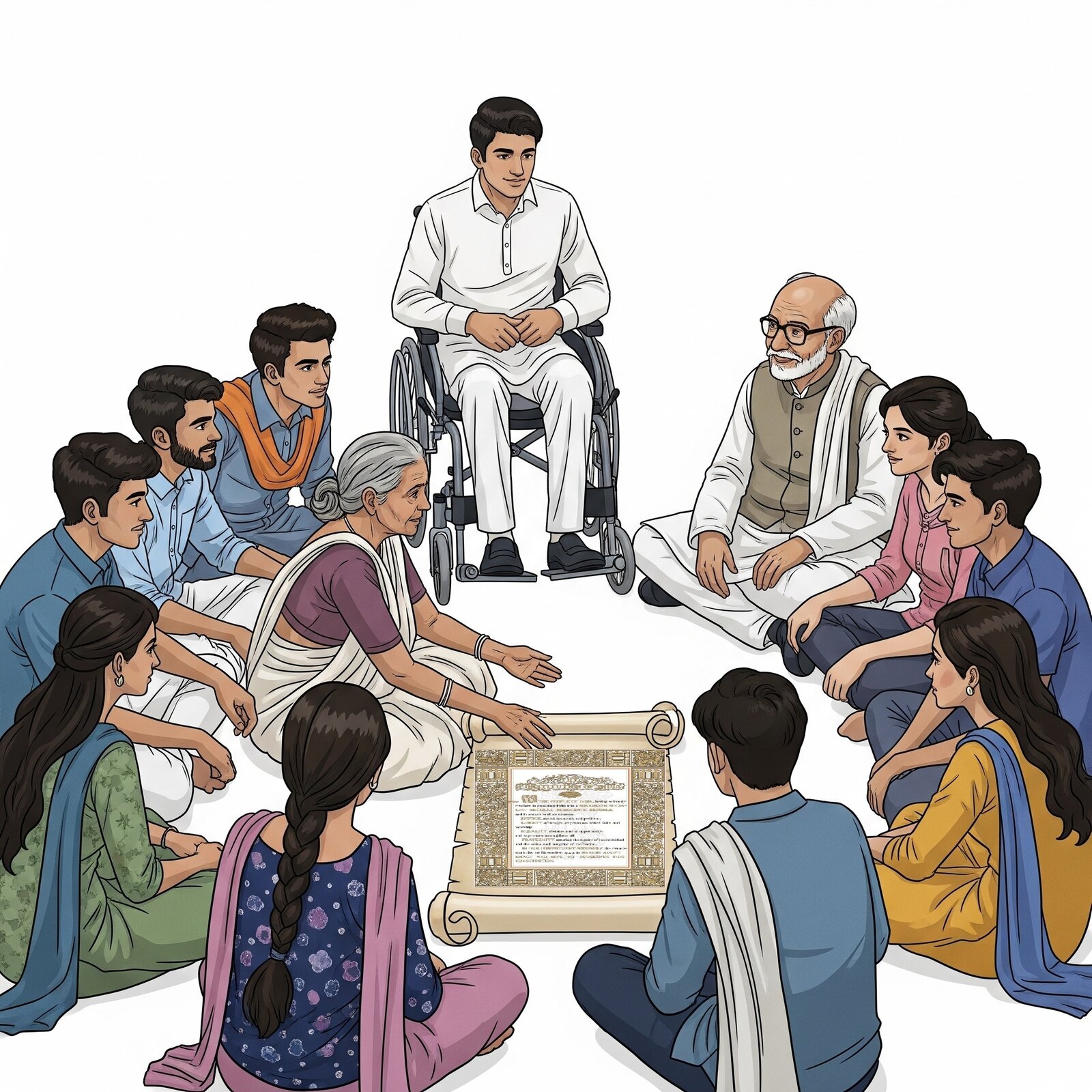
The concept of fraternity appears to be deeply etched as a foundational value in the opening declaration of our Constitution itself — “We the People of India”. Two important senses of the term ‘we’ need to be distinguished and clarified before moving further. ‘We’ (uppercase), in this context, will be used to refer to the ideal mentioned in our Constitution, whereas ‘we’ (lowercase) refers to the generic, everyday reference to the people of India. The following questions about ‘We’ in “We the People of India” deserve further exploration. The foremost is, “What is the meaning of this ‘We’?” And the second related question is whether ‘we’ are actually the ‘We’ who are adopting, “offering to ourselves”, and enacting the values of justice, equality, and freedom for all. Further, if the ‘we’ does not already incorporate the latter signification, then how can we achieve and realise such a ‘We’? Interestingly, the possibility of becoming and actualising this ‘We’ is implicit in the very query “How can ‘we’ become that ‘We’”?
Pondering over these questions and finding plausible answers requires that we take a small historical detour. A seemingly commonplace way of looking at the history of India’s struggle for freedom suggests that perhaps each individual participant was ultimately fighting for their own freedom, and that therefore “freedom” could have had different meanings for different individuals. For instance, some people would have considered freedom as an overarching freedom from imperialist domination, while others would have thought of it as a rather specific and immediate freedom from the person who happened to encroach upon their living space, movement, and choice. Despite this difference in the understanding of what freedom and independence ultimately entail, most of them collectively participated in celebrating freedom from British rule.
For some, the realisation of that freedom ultimately meant having to leave their homes might have even felt like betrayal. This is aptly depicted in a scene from the movie Begum Jaan (2017), where when Begum Jaan and her friends realise that as a consequence of their new-found freedom their house is being taken away, the celebration of freedom becomes meaningless. Similarly, in Satinath Bhaduri’s novel Dhoday Charitmanas (originally in Bengali, Hindi translation, 2008), a character gets a smaller compensation for losing his entire house as compared to those who lost only a small portion. This inequitable acknowledgment of loss makes the character question the very nature and value of the freedom being thus bestowed.
For the actualisation of this ‘We’, (in “We the people of India”) what might really be required after all is neither conditioning nor imposition, but swaraj (self-rule). For it is through swaraj that a person constantly examines his/her self vis-a-vis other selves. This continuous self-examination gets actualised through a dialogue, in which the very desire to be associated with another in dialogue, is the fundamental requirement, and not being liberated from all prejudices or differences.
It thus becomes evident that there can be diverse meanings that get attached to what we commonly value. While we all value “freedom”, still what we really intend to mean when we refer to this value might be different across individuals, communities, contexts, etc. However, how are we then to make sense of the ‘We’ engraved in the Constitution. Does the value enshrined in and through this ‘We’ also entail diverse unidentical meanings? Is this ‘We’ then a gross impossibility, an impractical, and unachievable ideal? Or is this ‘We’ in fact realisable, but only when everyone becomes conditioned towards the particular meaning granted to it by some particular individual? The latter may happen when everyone ends up granting a privileged status to that individual person, reckoning their way of life as aspirational and worthy of emulation.
However, if this is so, then what is the status of the essence of our Constitutional Preamble, which announces that “We the People of India” have offered the Constitution to ourselves? “Offering” indicates a sense of devotion, and offering the Constitution to ourselves indicates our devotion towards ourselves, our devotion to be and become a ‘We’. Perhaps then, for the actualisation of this ‘We’, what might really be required after all is neither conditioning nor imposition, but swaraj (self-rule). For it is through swaraj that a person constantly examines his/her self vis-a-vis other selves. This continuous self-examination gets actualised through a dialogue, in which the very desire to be associated with another in dialogue, is the fundamental requirement, and not being liberated from all prejudices or differences.
Furthermore, this dialogue is a relational enterprise and, as the grammarian Bhartrhari notes in the magnum opus Vakyapadiyam, every relation depends almost entirely on the nature of the ‘relata’ (what is being related). Dialogue too inherently depends on who we are and who we will evolve into. Here, it is worth noting that truthfulness can be highlighted as an enabling condition for dialogue, which is founded on trusting the other that they would at least not lie about themselves. However, the present article centers around the underlying confidence that in expressing oneself to the other, one would not be judged for the revelation, and also that the revelation would not be misused. Any disregard and violation of this trust would cause reluctance in revealing oneself sincerely in dialogue. Dialogical engagements thus require a continuous reassurance and nurturing of the trust on the part of both the relata. This perpetual nurturing requires that the relata constantly observe themselves, their participation in the dialogue, as well as the unfolding of the dialogue itself, or else it would degenerate into mere habit. In habit, the value of the other is not constituted from ‘their being a living, evolving, dynamic personality’ or as ‘being someone’, but rather it gets constituted by them ‘being known’ or them merely ‘being’. As soon as one gets the impression that the other is becoming or evolving into something apart from how we have known them and what we have been habituated to, then the other gets qualified as a threat to our identity and ego, and therefore as someone with whom we cannot continue to live in harmony any more.
The point that I wish to emphasise upon is that the ‘We’ of “We the People of India” is not to be conflated with the mundane mainstream understanding of a ‘We’, which is the outcome of a ‘cultural consensus’ or habituation, in which a large majority of the country’s population gets itself counted without ever participating in a dialogue or even thinking. Ironically, this conception of ‘the mainstream’ itself is inherently undemocratic. Democracy does not imply the mere amassing of a consensus by any means whatsoever. Instead, it allows for the gradual flourishing of a consensus which emerges in and through a dialogical engagement, in which reaching a decision does not depend upon dissolution of disagreements. In democracy, therefore, disagreements are neither merely registered, nor entirely eliminated; rather, they remain intact throughout as possible guiding posts for the future.
While our identities are undeniably conditioned by our facticity, still education is a ray of hope which facilitates for each one their own continuous and gradual becoming of ‘We’.
The Constitutional reference to ‘We’ may also be understood as symbolically representing a source of power. But the question remains whether ‘We’, i.e. the voters and citizens, have in fact been able to actualise that ideal ‘We’, or is this only a farce, with which we are deceiving ourselves and with which we are being deceived.
One way of establishing that ‘we’ have not yet become the ‘We’ is to argue that if we were already a ‘We’, then we would not have demanded the creation of a law for managing everything. This need and demand is the symptom of what may be labelled as ‘the third-party mindset’. As Gandhi would have suggested, this third-party mindset is what compels us into believing that relations between individuals cannot be created or nurtured by themselves, and also that if there were no third parties mediating, people would have always stood against each other with open swords. Fraternity, according to this mindset, is realised only through the involvement and intervention of a third party. All this further indicates that perhaps the need of being ‘governed’ is deeply ingrained in our psyche. But this inherent dependence on a mediator is not what we can call ‘self-offering’, or giving to ourselves.
Furthermore, ‘We’ does not imply an obligation to make someone else ‘We’ by imposition; all that it implies is that each one of us would have to become ‘We’ ourselves. This ‘We’ is neither indicative of a group of people, nor is it a collective declaration made by many that ‘we’ are ‘We’. Rather it is the very actualisation of the ideals and values like freedom of others, equality with others, and dignity of others. It involves the discovery and fructification of those values in ourselves while endorsing the feeling of freedom, equality, dignity and fraternity for all others.
The question we need to ask once again is — have ‘we’ already become this ‘We’; if not, then can we ever even achieve it, and how?
The people of India were not in possession of a magic wand which, with just one wave in 1947, would have made all a ‘We’. Nor were the people living by any identical set of values, which would have led everyone into automatically and equally adopting the ideals that arose as a reaction of rejecting imperialist or colonial rule. Nor can Time ever be neatly segregated into two parts. Old and New are merely relative conceptions and we grow with both sets of values — old and new— simultaneously. We can truly become ‘We’ only if we sincerely want to become ‘We’.
As Ambedkar observes, no idea, event, situation or thing can make us a nation, unless ‘we’ have in us the firm ‘determination’ of becoming a nation 1. The prospect of manifesting that firm determination and of becoming that ‘We’ is already inherent in each one of us. While our identities are undeniably conditioned by our facticity, still education is a ray of hope which facilitates for each one their own continuous and gradual becoming of ‘We’. An education which makes us experience ‘otherwiseness’; i.e., an education which helps us appreciate that things can be otherwise, events can happen otherwise, and ideas can be thought otherwise.
About the author
Ashutosh Vyas studied philosophy at University of Delhi, and currently teaches at Azim Premji University, Bhopal. His research interests include philosophy of language, Bhartrihari’s philosophy of grammar, philosophy of education, ideas of Samvada and Swaraj, and the relation between Swaraj and education.